
Machine Learning for Property-Guided Surfactant Design: Faster Formulation, Fewer Failed Experiments
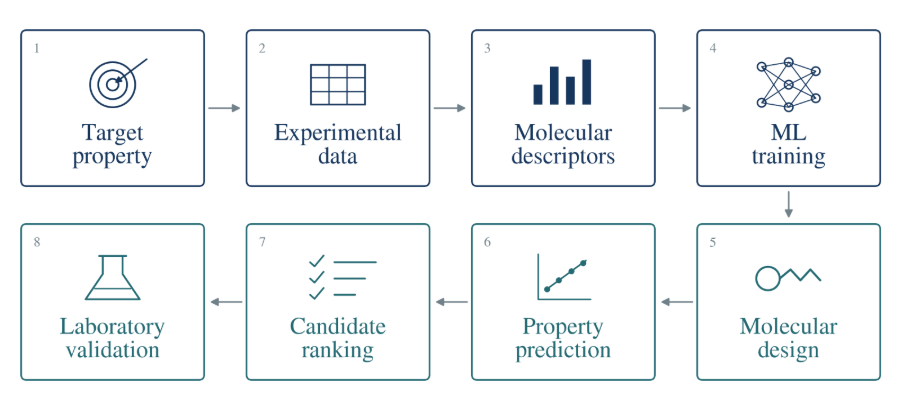
Machine learning connects industrial requirements with surfactant design through a continuous workflow. A defined target guides data collection, molecular representation, model training, prediction, and candidate selection. This process helps focus experimental screening and reduce associated costs. The end user or company validates selected molecules, providing evidence that supports further refinement.
Keywords: surfactants; machine learning; molecular descriptors; property prediction; experimental validation
Surfactants use for cleaning, emulsification, and wetting applications. They are used across different industry such as, detergents, personal care, pharmaceuticals, agriculture, and oil recovery. Each industry requires different properties: detergents prioritise cleaning, personal care emphasises mildness, pharmaceuticals require compatibility and solubility, agriculture focuses on wetting and spreading, and oil recovery targets low interfacial tension. These needs drive the search for new surfactants. But the chemical space is large, so screening experimentally is costly and slow. Machine learning eases that burden by linking experimental evidence with molecular features, which helps researchers design and pick promising candidates for a given application.
The first step is to turn an application need into a defined target property. A formulation that requires rapid action, for example, may need surfactants that adsorb quickly at an interface. So, the target must include both the desired behaviour and the conditions that apply. Fixing concentration, temperature, and the surrounding fluids gives a consistent basis for collecting data and comparing candidate molecules.
Next, experimental measurements show how known surfactants behave under these conditions. Preparing this dataset involves checking chemical identities, units, missing values, repeated entries, and measurement methods. These checks help separate differences caused by molecular structure from those caused by experimental conditions. A clean dataset is what lets the model relate chemical structure to the selected property.
A model needs numbers, so molecular descriptors turn each chemical structure into numerical information. Features such as molecular size, charge, and polarity capture aspects of surfactant behaviour, while structural representations capture differences in the head group, linker, and tail. Add the experimental conditions, and the model can learn how molecular features relate to measured performance.
The model learns these relationships from training data, and separate datasets are used for model selection and evaluation. Keeping related structures together when dividing the data helps assess predictions for unfamiliar surfactant families. Prediction errors and uncertainty show where the model is useful and where more evidence is needed. That decides how far the model can be trusted when exploring new molecular designs.
New candidates come from changing the head group, linker, or tail. Chemical validity and synthesis constraints limit the search. The trained model then predicts the selected property for each candidate under defined conditions, which narrows a broad set of possible structures to molecules with estimated performance.
The predictions are then used to rank candidates. Comparing expected properties with uncertainty, chemical feasibility, and application requirements identifies molecules worth pursuing. Ranking directs experimental resources towards a smaller, more promising group of candidates.
The selected candidates then pass to the end user or company for laboratory validation under relevant application conditions. Comparing measurements with predictions shows how each candidate performed and where the model can improve. New measurements go back into the dataset for the next cycle of property-guided surfactant design.