
Enzyme Property Prediction and Optimization Using Artificial Intelligence
Enzyme property prediction and optimization
Enzymes are central to pharmaceutical manufacturing, industrial biocatalysis, synthetic biology, food processing, and sustainable chemistry. However, naturally occurring enzymes rarely possess all the characteristics required for a specific application. An enzyme may catalyze the desired reaction but have poor thermostability, limited substrate scope, low solubility, or insufficient catalytic efficiency.
Enzyme engineering therefore aims to improve properties such as catalytic activity, substrate specificity, stability, solubility, and expression. The challenge is the enormous protein sequence space: even a modest protein can have more possible variants than anyone could realistically make and test in a laboratory. That is where enzyme property prediction and in silico optimization come into play.
In simple terms, enzyme property prediction uses computational models to estimate how an enzyme will behave before testing it in the laboratory. Researchers may want to predict catalytic activity, substrate specificity, thermostability, solubility, expression level, selectivity, or tolerance to solvents and changes in pH.
The standard approach: screening and directed evolution
Traditionally, enzyme optimization has relied heavily on rational design, directed evolution, or combinations of the two. In rational design, structural and biochemical knowledge is used to identify residues likely to influence a desired property. Selected mutations are introduced and experimentally evaluated. Directed evolution takes a broader approach: libraries of variants are generated through mutagenesis or recombination, followed by screening or selection to identify improved enzymes.
These methods have produced highly successful engineered enzymes, but they can require multiple rounds of library generation and experimental screening. Importantly, optimization is rarely based on
a single property. A useful industrial enzyme may need to combine high catalytic activity with stability, selectivity, solubility, and compatibility with process conditions. Computational prediction can therefore act as a filter between library generation and experimentation, reducing the number of variants that need to be physically produced and tested.
AI and ML: toward predictive enzyme engineering
Artificial intelligence and machine learning are increasingly being used to predict enzyme properties directly from sequence and structural information. Modern models can estimate properties including enzyme structure, kinetic parameters such as (kcat) and (Km), substrate specificity, thermostability, solubility, and biological function. As an example, protein language models learn statistical patterns from millions of protein sequences and generate representations that capture information related to evolutionary conservation, structural patterns, and biochemical function.
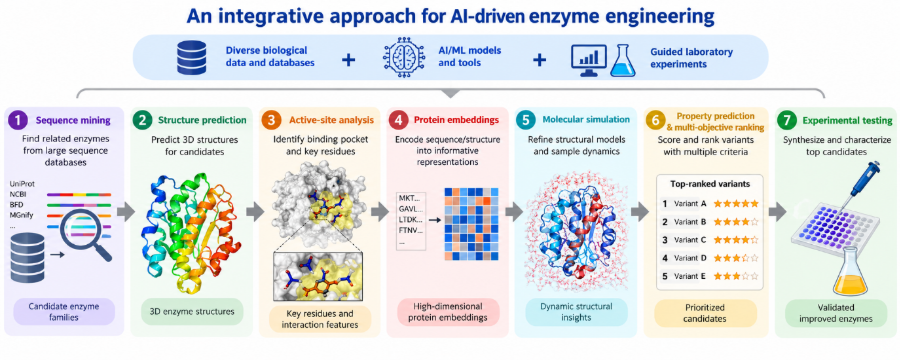
An integrative approach brings such computational tools and datasets together before and between laboratory experiments.
Overview of an integrative AI-driven pipeline for enzyme property prediction, optimization, and engineering.
A practical pipeline might combine sequence mining, structure prediction, active-site analysis, protein embeddings, molecular simulation, property prediction, and multi-objective ranking. For example, sequence-based models can identify enzymes related to a desired reaction. Structure-based methods can highlight residues near the active site. A machine-learning model can then rank mutations for activity or thermostability, while a solubility predictor removes candidates that are unlikely to express well. The final shortlist can be synthesized and tested experimentally. Such approach rather than relying on one prediction model in isolation connects enzyme discovery, variant design, manufacturability, and process performance in one workflow.
Ultimately, the greatest potential lies in closed-loop design–build–test–learn workflows. AI proposes promising variants, experiments measure their properties, and the resulting data are fed back into the model to guide the next generation. In this framework, AI helps determine which experiments are most informative and which enzyme variants are most worth testing.