
Structure-Activity Relationship (SAR): How Molecular Changes Guide Better Drug Design
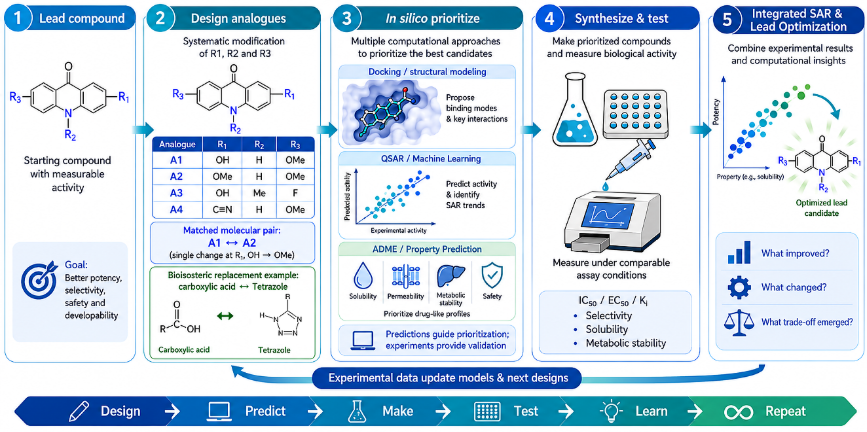
Finding a molecule with biological activity is only the beginning of drug discovery. A promising compound may still need better potency, selectivity, solubility, safety, or pharmacokinetic properties. Structure-activity relationship (SAR) studies help researchers understand how changes in a molecule’s chemical structure affect its biological activity and use that knowledge to guide lead optimization.
What is SAR?
SAR compares a group of structurally related compounds and examines how specific chemical changes influence a biological response. Researchers may modify a substituent, functional group, ring system, linker, charge, polarity, or stereochemistry and then compare the resulting activity.
For example, adding a fluorine atom at one position may improve activity, while the same change at another position may reduce it. Such observations help identify which molecular features are important, which regions can tolerate modification, and which changes should be avoided.
How are SAR studies performed?
A reliable SAR study starts with a defined target, assay, and activity endpoint such as IC₅₀, EC₅₀, or Kᵢ, measured under comparable conditions. Researchers then create and test analogues by making focused structural changes and observing their effects on activity.
Common approaches include matched molecular pair analysis, which compares compounds differing by a small structural change, and bioisosteric replacement, where one functional group is replaced with another to retain key biological interactions while modifying properties such as lipophilicity, solubility, or metabolic stability.
The process is iterative: Design → Synthesize/Test → Analyze → Redesign.
Lead optimization therefore aims to balance potency with selectivity, solubility, permeability, safety, and synthetic feasibility.
SAR vs QSAR
SAR is generally qualitative or semi-quantitative. It produces observations such as “this group improves activity” or “this position is sensitive to modification.”
Quantitative Structure-Activity Relationship (QSAR) goes a step further. Molecular structures are converted into numerical descriptors or fingerprints, and mathematical or machine-learning models are used to predict a defined biological or physicochemical property.
A good QSAR model should have a clearly defined endpoint, appropriate validation, and an applicability domain indicating the chemical space in which its predictions are considered reliable.
Role of Computational Methods and AI/ML
Computational approaches can make SAR analysis faster and more systematic. Ligand-based methods use molecular similarity, fingerprints, clustering, and activity data to identify useful structural patterns. Structure-based approaches such as molecular docking and molecular dynamics can help propose why a structural modification may alter binding, although computational predictions should support (not replace) experimental evidence.
Machine-learning models can learn relationships between molecular structure and activity from larger datasets. Common approaches include random forests, support-vector machines, gradient boosting, and graph neural networks (GNNs).
More recent approaches also use transfer learning, uncertainty estimation, and generative models to prioritize or propose new analogues.
However, more complex AI does not automatically mean better SAR. Model performance depends strongly on data quality, assay consistency, chemical diversity, and realistic validation. For example, having very similar compounds in both training and test datasets can make predictive performance appear better than it actually is.
Conclusion
SAR remains one of the core approaches in medicinal chemistry because it converts experimental observations into practical molecular design rules. Modern computational and AI methods can help analyze larger chemical spaces and prioritize compounds, but reliable drug design still depends on high-quality experimental data, careful validation, and repeated testing.
In practice, the strongest approach combines medicinal chemistry, biological assays, computational modeling, and data science in a continuous learning cycle.
Curious about how we’re exploring this at @Prescience? Reach out to us at support@prescience.in.